Rebuilding the tool that runs every bus trip in every city.
Chalo AFCS is the back-office system transit teams use to run fare collection across a city — from logging in each morning to reconciling the day's cash. I led a revamp spanning four core flows: the login & dashboard, waybill creation, role-based access, and fare collection.

MY ROLE
Product Designer
TEAM
1 Designer, 1 PM, 3 Developers
TIMELINE
2 months
CONTEXT
The system
AFCS — the Automatic Fare Collection System — is the back-office tool Chalo's transit teams use to run and manage bus fare collection across a city. It sits behind the physical ticketing hardware (ETIM machines on the bus, driver consoles, prepaid-card readers) and turns what happens on the road into structured, reconcilable data. In Chalo's own words, it's the hub of all the data needed to operate a city.
The waybill is the operational document at the centre of it. It binds a vehicle, a crew member, a route or schedule, an ETIM, and a ticket inventory into a single record. Every rupee collected on a bus is traceable back to a waybill.
Cashier — marks collections and checks sign-off reports for their assigned depot.
Depot Manager — creates and edits waybills, oversees all activity at a depot.
Operations Manager — manages a team of depot executives across a city's operations.
City Owner — full access; supervises every activity across the city.
4 MAIN FLOWS
Login & Dashboard
01
The first screen every role sees each morning — and the one that didn't meaningfully exist before.
Waybill creation
02
The form that authorises every bus trip, binding vehicle, crew, route, hardware, and inventory into one record.
Role-based access
03
What each of the four roles can see and do — the difference between a focused tool and an overwhelming one.
Fare
collection
04
Reconciling the day's cash against ETIM data and closing out the shift.

The two ends of that chain — Creation and Collection — are the screens this case study is about. At the Wadala Depot session I worked from, that's 443 waybills/day across 102 buses and 161 conductors, all flowing through these two screens.
CHALLENGES
Three problems, felt everywhere.
AFCS worked — cities were running real operations on it. But three structural problems ran through the entire product, showing up in every flow rather than any single screen. They were the reason the revamp had to be product-wide, not flow-by-flow.
There was no dashboard for the overall system
— Logging in dropped the user straight into a data table. There was no landing view — no answer to "what's the state of my depot / my city right now?" A City Owner responsible for an entire city and a cashier responsible for one depot saw the same undifferentiated starting point. The most important question the tool could answer — how are we doing today? — had nowhere to live.
Too many unnecessary fields — cognitive load across every form
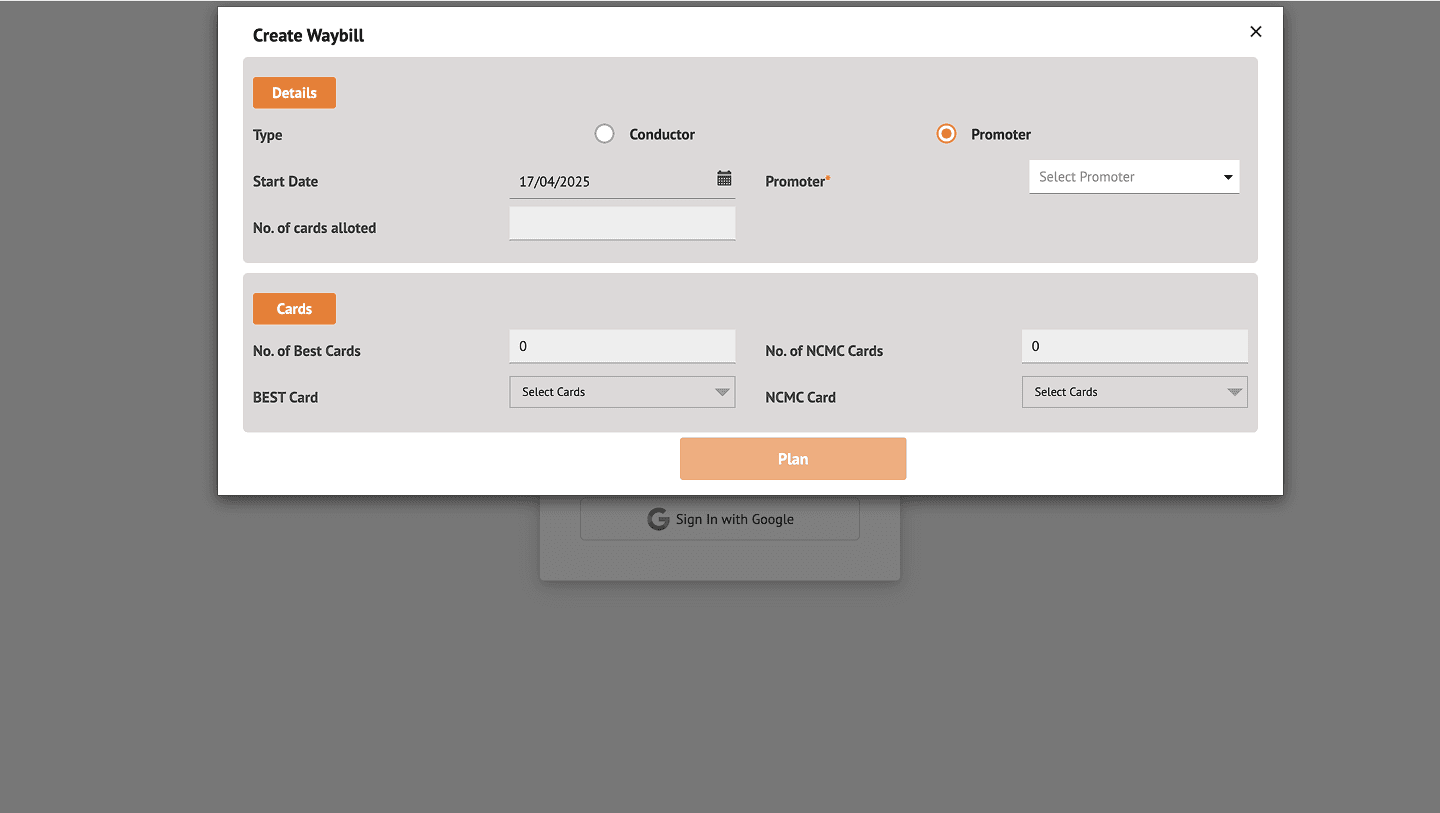
— Forms across AFCS showed every possible field to every user, regardless of whether it applied. Waybill creation ran ~14 fields even when the scenario needed three. The collection form and master-data forms had the same problem: fields without helper text, repeated fields under different names ("actual cash", "cash in hand", "settlement amount" all meaning the same thing), and jargon (Rolls, Blocks, Prefix, NCMC) with no explanation. Every extra field is a decision the user has to make or dismiss — and at depot scale, those decisions compound into errors that need backend support to fix.
The navigation was broken
— The left sidebar exposed all seven modules to every role at all times. Beyond the clutter, it had literal defects: a menu item pointing to a dead route (
/home/undefined), a raw untranslated label leaking to the UI, a duplicated report entry, and nav items that lost both label and icon when the sidebar collapsed — becoming invisible and unreachable. There was no role-based scoping, so an auditor waded through City Management and Master Data they'd never use.These three weren't isolated bugs. They were symptoms of a product that had grown feature-by-feature without a holistic pass — and they're what the revamp set out to fix at the root.


RESEARCH
Problems came from depots, not design review.
The revamp scope wasn't decided from a designer's chair. It was built from three layers of work, and only after the research did the design begin:
Field study at depots — sitting alongside regular users to understand each flow end-to-end. Specifically: time taken to create a waybill, and ease of submitting the collection form.
Video calls with city teams — Indore, Kerala, Mangalore, Shimoga, Coorg, Moodbidri, Tumkur — capturing recurring issues, particularly around the Collection page.
Problem-theme consolidation — cross-checking complaints across cities to find the recurring ones, not the one-off requests.
Key Insight
This is what elevated the work from cosmetic to operational. The Collection screen wasn't just visually weak — it was causing mistakes depot staff couldn't fix themselves, forcing escalation to the AFCS support team. Every backend force-sync is a person somewhere doing work the system should have prevented.
Issue maps to
Findings
01
No dashboard
No landing view after login; live ticketing data existed at depot level but had nowhere to surface.
02
Field overload
Repeated fields under different names; jargon without helper text; every field shown to every user.
03
Broken navigation
Dead nav route, duplicated report entry, untranslated label leaking to UI, no role scoping.
04
Collection clarity
Sync disabled in some cities; users dependent on backend force-sync.
05
Waybill creation
"Clarity in waybills creation, updation and deletion" — the single top improvement item.
Improvement required in collections page as there can be confusions and mistakes which then require backend support.
— Indore city team
If the waybill is not synced in AFCS then users can also not sync it from their end — the option is disabled for these cities
— Problem themes, multi-city
For single date, bulk upload of waybill works. But for multiple dates, weekly… it fails.
— Field study, depots that pre-create weekly
SOLUTION
The solution addressed the three challenges flow by flow. Each of the four core flows either introduced something missing (a dashboard, role scoping) or restructured something overloaded (creation, collection).
LOGIN &
DASHBOARD
Give every role something to land on
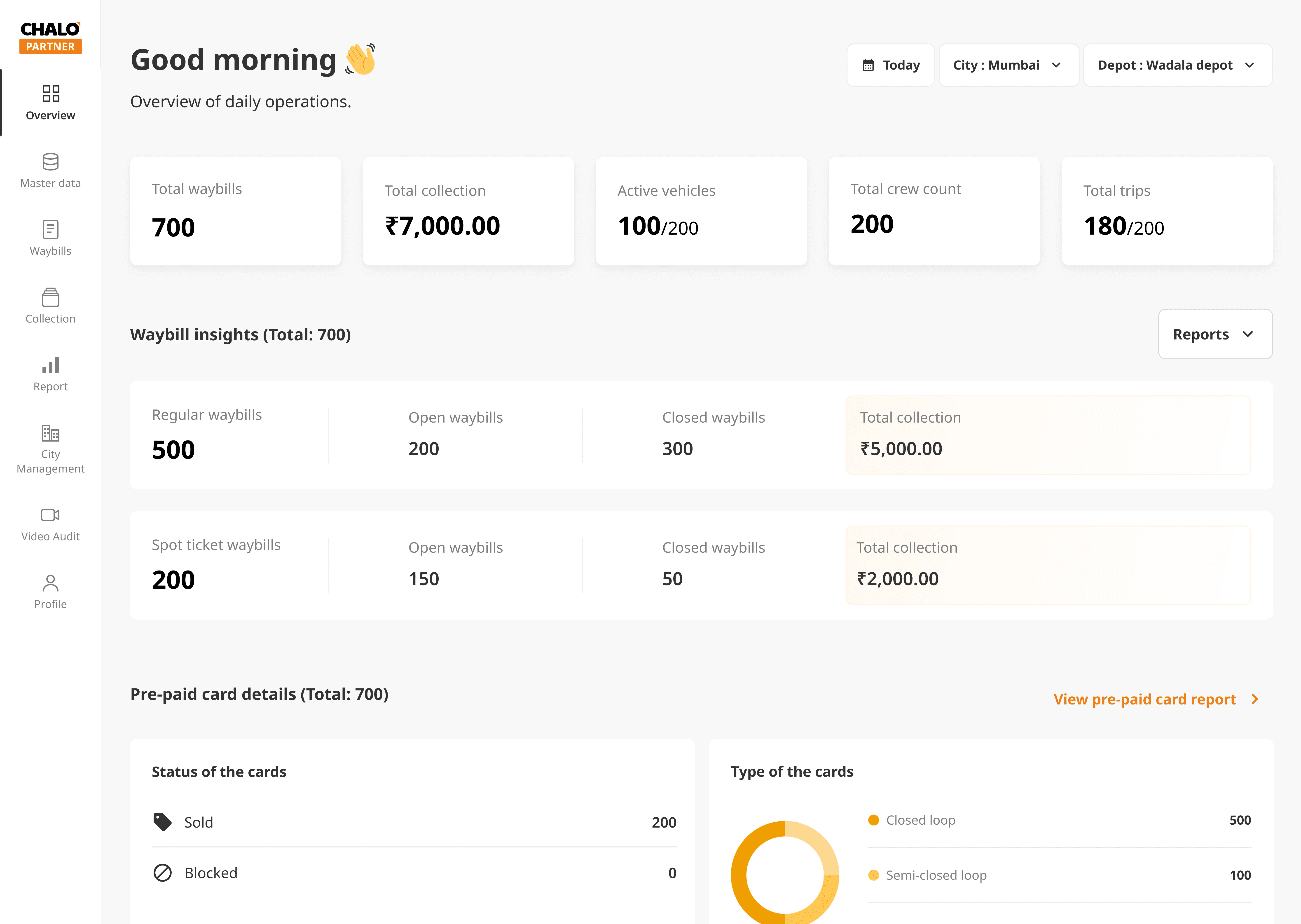
The revamp introduces a dashboard as the post-login home — the answer to "how are we doing today?" that the old tool never gave. It surfaces the live state of the depot or city (collection so far, waybill and sync status, what needs attention) scaled to the role viewing it, so a City Owner sees city-level health and a cashier sees their depot.


WAYBILL
CREATION
Put the choice before the form; show only what applies
Creation moved from a modal to a full page, and — the load-bearing decision — the waybill type now sits at the top as a switcher: Regular · Spot ticket · Ground ticket · Tap in tap out. Each type loads only its own fields. The promoter path drops from ~14 fields to 3. The submit button says Create waybill, not the old ambiguous Plan.


Put the choice before the form; show only what applies
Creation moved from a modal to a full page, and — the load-bearing decision — the waybill type now sits at the top as a switcher: Regular · Spot ticket · Ground ticket · Tap in tap out. Each type loads only its own fields. The promoter path drops from ~14 fields to 3. The submit button says Create waybill, not the old ambiguous Plan.

ROLE BASED
ACCESS FLOW
Show each role only what its job needs
The old sidebar showed all seven modules to everyone. The revamp scopes navigation to the role: each of the four roles sees only the modules relevant to their job, and the broken nav is fixed at the root — the dead route, the duplicated report entry, the untranslated label, and the collapse-state disappearing items are all gone.


FARE COLLECTION
From a status flip to a reconciliation workspace
Collection moved from a flat sync-monitor table to a proper workspace, split into Open waybills and Summary. Sync status became colour-coded pills — Synced Not synced — and the row action was renamed Close waybill, disabled with a tooltip ("Waybill has to be closed on ETIM first") when the precondition isn't met. Closing a waybill now opens a structured form — manual sales, denomination entry, short/expenses, inventory — with a live Net collectible chip that turns red the moment cash doesn't reconcile.

THE PRINCIPLES
Make the choice explicit before showing the form.
01
Type pills, view tabs, role-scoped nav. The interface narrows the world before the user has to.
Engineer risks out, don't patch them.
02
Full page instead of a dismissable modal; disabled actions instead of error messages after the fact.
Show state; don't make users hold it.
03
The dashboard and the live Net collectible chip put status on screen instead of in someone's head.
Speak the user's vocabulary.
04
Create waybill, not Plan. Named types, deduplicated field labels, role-relevant menus.
The change — and how it's measured.
Each challenge maps to a concrete shift in the product:
Challenge
Solutions
01
No dashboard
A role-scoped dashboard as the home screen.
02
Field overload
Type- and role-aware forms; promoter path 14 → 3 fields.
03
Broken navigation
Role-scoped sidebar; defects fixed at the root.
04
Collection clarity
Reconciliation workspace with live Net collectible.
01
A place to land.
Every role now opens to a view of their day, not a data table.
02
Less to carry.
Forms and menus show what the role and task need — nothing more.
03
Fewer ways to fail.
Risks engineered out; status shown on screen; support tickets designed away.
Outcome
The old AFCS worked if you already knew how to use it. The revamp is built so that a city team — any role, on day one — can run their operation without the tool getting in the way.
REVIEWS
